One acre is a unit of land area that measures exactly 43,560 square feet. When people ask, "how big is 1 acre," the answer is consistently based on this fixed area rather than a specific physical shape. Understanding this fundamental unit of measurement is essential for anyone involved in agriculture, real estate, or land management.
MeasurementsSeptember 1, 2026
How Big Is 1 Acre? 43,560 Square Feet Explained
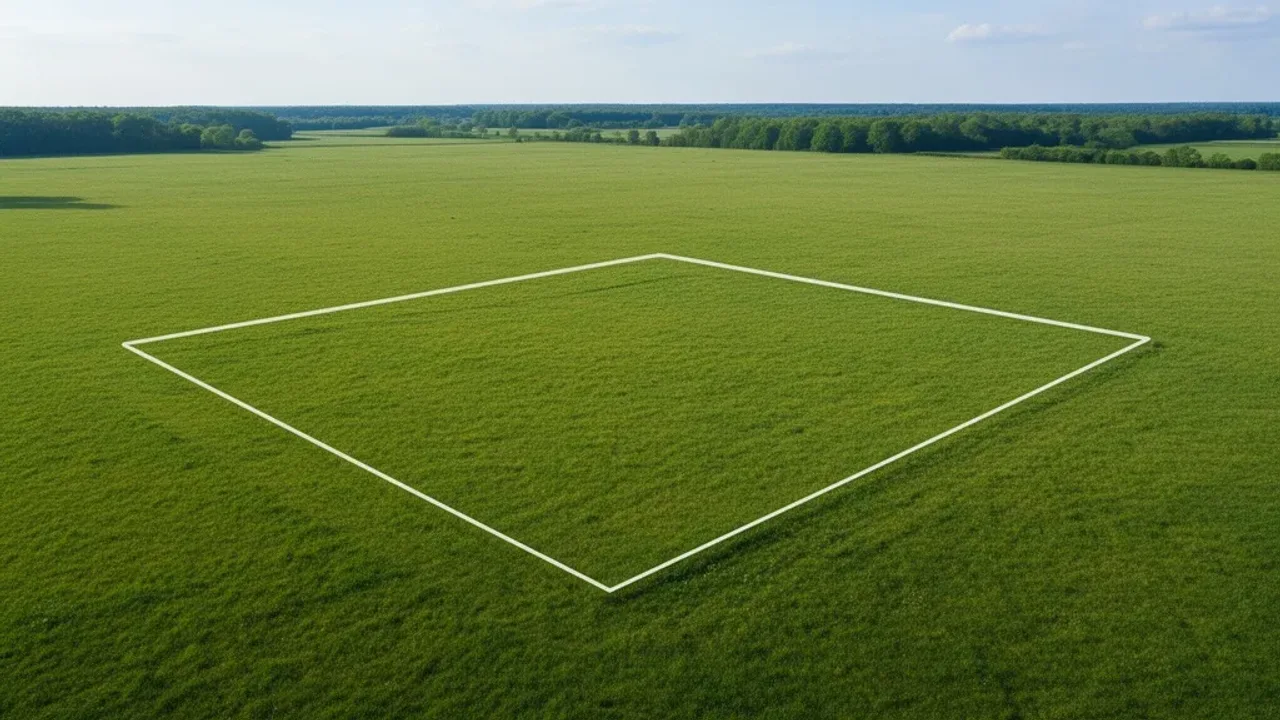 AI-generated image
Key Takeaways:
- An acre is defined as 43,560 square feet of land area.
- This unit is equal to 4,840 square yards or approximately 0.405 hectares.
- The shape of an acre does not have to be square; it can take any configuration that meets the total area requirement.
- Agriculture and real estate professionals frequently use this unit to measure land parcels and plots.
Defining the Size of One Acre
The acre serves as a traditional unit of measurement within the United States customary system and the British imperial system. It is strictly a measure of surface area rather than a specific shape. Historically, the definition evolved from the amount of land a team of oxen could plow in a single day. While that historical context is interesting, modern standards rely on precise mathematical definitions.
A square-shaped acre would measure roughly 208.71 feet on each side. However, the boundary lines of an acre can be adjusted to fit rectangular, circular, or irregular plots. If a parcel of land covers 43,560 square feet, it qualifies as one acre. This flexibility is why land surveyors and property developers can define diverse lot shapes while maintaining the same total area. Understanding "how big is 1 acre" requires focusing on the total square footage, which remains constant regardless of the land's specific dimensions.
| Unit of Measurement | Value per 1 Acre |
|---|---|
| Square Feet | 43,560 sq ft |
| Square Yards | 4,840 sq yd |
| Hectares | Approx. 0.405 hectares |
| Square Meters | Approx. 4,047 sq m |
| Rods | 160 square rods |
Practical Applications and Considerations
Acreage knowledge is essential for those involved in land management and property assessment. To effectively utilize these measurements, keep the following points in mind:
- Verify the total square footage to ensure accuracy when calculating land area for development or sale.
- Remember that 43,560 square feet is the constant value regardless of the parcel's perimeter.
- Consult official land surveys if you need to determine the exact boundaries of a specific acre in a complex landscape.
- Consider the intended use of the land, as topography and usable surface area may differ from the total measured acreage.
When working with land measurements, ensure you have the correct conversion factors ready. Standardizing your approach helps maintain consistency across different projects. Before finalizing any calculations, consider these steps to ensure your data is reliable:
- Confirm the units being used (feet, yards, or meters) before starting calculations.
- Use a reliable conversion chart to avoid errors when switching between imperial and metric systems.
- Account for potential variations in land topography that might affect the usable surface area for agricultural or construction purposes.
- Double-check calculations when dealing with non-rectangular lots, as these require more complex geometric formulas to verify total area.
The Evolution of Land Measurement
The concept of the acre has been a cornerstone of land division for centuries. In the United States, the Public Land Survey System (PLSS) often utilizes sections divided into smaller acreages. A standard section of land is one square mile, which contains 640 acres. Breaking this down helps professionals manage large-scale agricultural projects and residential zoning.
For those looking to visualize the size, think of a standard American football field. Excluding the end zones, a football field is 300 feet long and 160 feet wide, totaling 48,000 square feet. An acre is just slightly smaller than this playing surface. This comparison provides a quick mental reference for those struggling to grasp the scale of 43,560 square feet. It is a large enough space for significant activity, yet small enough to be managed by a single property owner.
Advanced Conversion Techniques
Precision is vital in real estate. When converting between units, small errors can lead to significant discrepancies over large areas. For example, converting square feet to hectares requires dividing by 10,763.9. Conversely, converting acres to square meters is achieved by multiplying by 4,046.86. Keeping these conversion factors accessible prevents common mistakes.
Professionals often use digital mapping tools to calculate acreage. These tools use GPS coordinates to plot boundaries and compute the internal area automatically. While these technologies are efficient, understanding the manual math behind the measurement remains a necessary skill for verifying digital data. If the software output seems unusual, manual calculation acts as a vital safety check.
Frequently Asked Questions
Is an acre always a perfect square?
No, an acre refers to a specific amount of area, not a particular shape. Land defined as one acre can take any geometric form, such as a long rectangle or a circle, as long as the total area remains 43,560 square feet.
How does an acre compare to a hectare?
An acre is smaller than a hectare. One hectare is equivalent to approximately 2.47 acres, making the acre roughly 0.405 hectares. This conversion is standard in international land measurement contexts.
Can an acre be measured in square yards?
Yes, one acre is exactly 4,840 square yards. This conversion is derived directly from the standard definition of 43,560 square feet. It is a common unit for smaller land plots.
What is the metric equivalent of an acre?
One acre is approximately 4,047 square meters. This conversion is particularly useful when comparing United States land measurements with international metric standards used in scientific or global agricultural reports.
Why is the acre used so frequently in real estate?
The acre remains a standard unit of measurement for residential and agricultural land in the United States. It provides a consistent scale for buyers and owners to understand the size of their property, making it the preferred unit for legal descriptions and property deeds.
Are there different types of acres?
In most modern contexts, the acre is standard. While historical variations existed in different regions, the international acre of 43,560 square feet is the legal standard recognized for land transactions and surveying today.
Summary
Knowing that "how big is 1 acre" equals 43,560 square feet is the primary requirement for accurate land assessment. Always verify your total square footage first, as the shape of the land does not change the defined area of the acre.
Share: